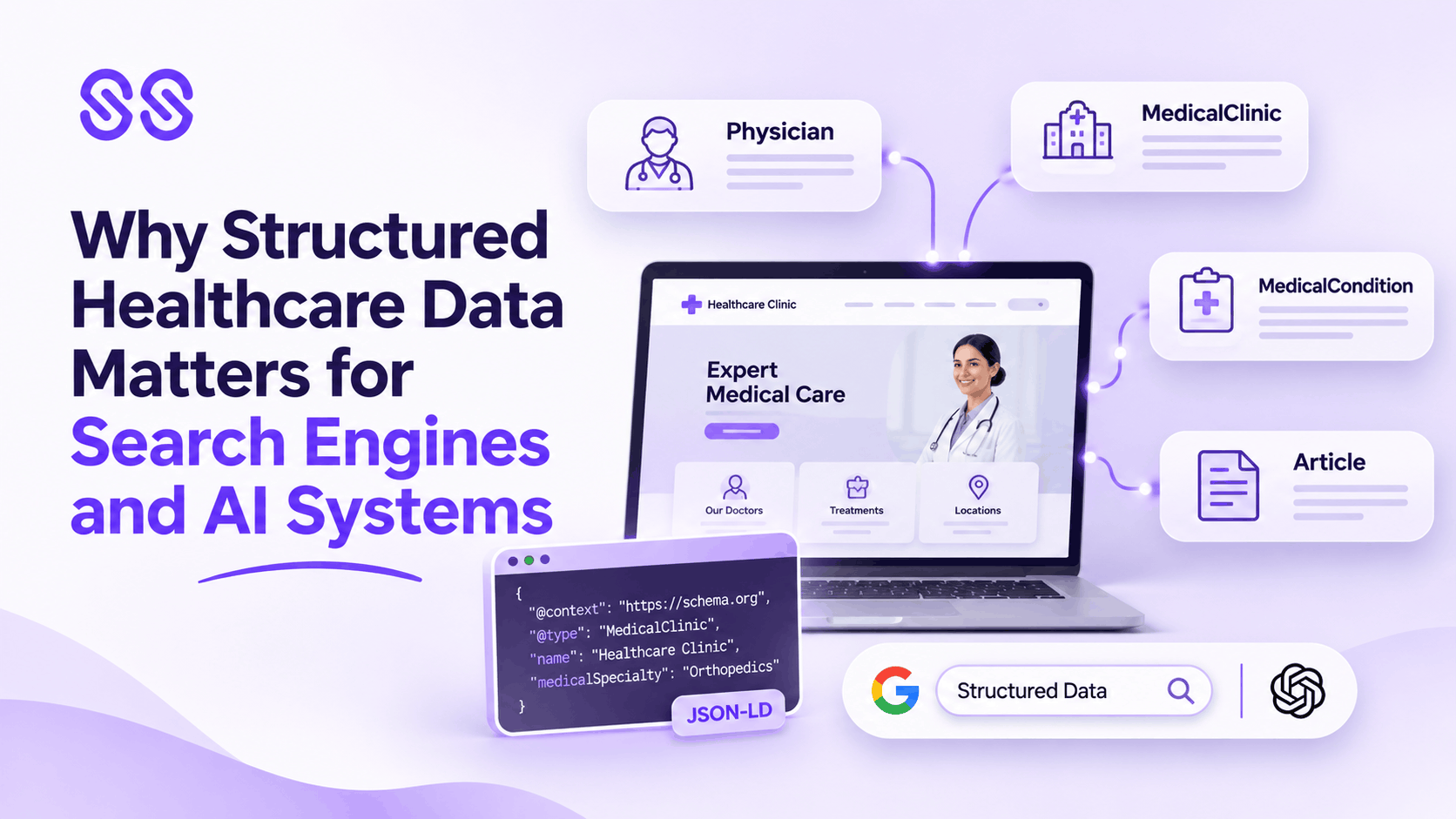
Healthcare websites contain a wide range of information, including medical services, treatment descriptions, doctor profiles, clinic locations, educational articles, and frequently asked questions. While this information is valuable to patients, search engines and AI systems need to understand how different pieces of information relate to one another.
This is where structured data becomes important.
Healthcare structured data helps describe website information in a machine-readable format. It provides additional context about medical professionals, healthcare organisations, services, articles, and other entities, making it easier for search systems to interpret the information accurately.
As search experiences evolve beyond traditional blue links, structured data is becoming an important part of technical healthcare SEO. It can support how search engines interpret medical websites and how information is connected across the wider digital ecosystem.
For healthcare practices investing in SEO, AEO, and GEO, understanding structured data is essential for building a technically organised and machine-readable online presence.
What Is Healthcare Structured Data?
Healthcare structured data is information organised using a standardised vocabulary so that search engines and other systems can understand the meaning and relationships between website elements.
Most websites use Schema.org vocabulary with JSON-LD as the preferred implementation format for many structured data use cases.
For example, a healthcare website may contain a doctor's name, qualifications, specialty, clinic address, and contact information. Without structured data, search engines primarily interpret this information from the page content and its HTML structure.
With appropriate schema markup, the website can explicitly describe the entities and their relationships.
Structured data can help identify:
- Healthcare organisations and clinics.
- Individual physicians and medical professionals.
- Medical specialties and services.
- Medical conditions and procedures.
- Articles and educational resources.
- Physical clinic locations.
- Author and reviewer information.
The purpose is not to add hidden keywords or manipulate rankings. It is to provide a clearer description of information already available on the website.
Also Read About - Best Digital Marketing Strategies for Ophthalmology Clinics
Why Structured Data Matters for Healthcare SEO
1. Helps Search Engines Understand Medical Website Content
Healthcare websites often have complex information architecture. A single clinic may have multiple departments, doctors, treatments, and locations.
Structured data helps describe these elements using consistent identifiers and relationships.
For example, a clinic's website can identify a physician as a medical professional associated with a particular healthcare organisation. It can also describe the physician's specialty and professional profile.
This additional context can help search engines interpret the website more accurately.
2. Supports Search Engine Entity Understanding
Search engines do not simply process individual keywords. They also attempt to understand entities such as people, organisations, places, and medical concepts.
For healthcare websites, relevant entities may include:
- The healthcare organisation.
- The doctors working at the clinic.
- Medical specialties.
- Treatment services.
- Clinic locations.
- Medical conditions and procedures.
Structured data can help connect these entities.
For example, a dermatology clinic may use organisation and physician markup to describe its identity and medical professionals. Its treatment pages can then provide additional context about the services it offers.
This creates a more organised representation of the clinic's digital information.
3. Supports Eligible Search Enhancements
Some types of structured data can make pages eligible for specific enhanced search appearances, depending on Google's requirements and the search feature available.
For example, appropriate Article markup can help search engines understand an educational article's headline, author, and publication details.
However, adding schema does not guarantee rich results, higher rankings, or increased organic traffic. Search engines determine whether a page qualifies based on their own eligibility requirements and systems.
4. Helps Maintain Consistent Business and Professional Information
Healthcare practices often have information distributed across multiple pages and platforms.
Structured data can help establish consistency between the clinic's name, website, location, doctor profiles, and relevant professional information.
This is particularly useful for multi-specialty practices and organisations operating from multiple locations.
Accurate information is important because conflicting details can create confusion for both patients and search systems.
Also Read More - AEO vs GEO vs SEO: What Healthcare Brands Need to Know in 2026
Important Types of Medical Schema Markup
Healthcare websites can use different schema types depending on the content and purpose of each page.
The following are some of the most relevant options.
1. Medical Organization Schema
MedicalOrganization is a Schema.org type for describing an organisation involved in providing medical services.
It can be useful for healthcare providers that need to establish their organisational identity.
Relevant properties may include:
- Name of the organisation.
- Website URL.
- Logo.
- Contact information.
- Address.
- Relevant medical specialties.
- Parent or related organisation, where applicable.
For example, a multispecialty clinic can use MedicalOrganization markup to describe its identity and connect relevant information about its services and professional team.
2. Physician Schema
Physician is a Schema.org type that describes a medical professional or physician.
It can help communicate information such as:
- Doctor's name.
- Professional profile.
- Image.
- Medical specialty.
- Contact information.
- Workplace or associated organisation.
- Relevant professional information.
A dedicated doctor profile page is a suitable place to provide physician-related structured data, provided the markup accurately reflects visible page content.
Physician schema should not be treated as a ranking shortcut. Its purpose is to describe the professional and make the information machine-readable.
3. Medical Clinic Schema
MedicalClinic is useful for describing a clinic or medical facility.
It can provide context about the clinic's identity, location, contact details, and available services.
For healthcare organisations with physical locations, this type of markup can help describe the facility represented by a particular website page.
Each location page should contain accurate information about the actual facility. Avoid using one address or contact number to represent multiple locations incorrectly.
4. Medical Web Page Schema
Medical Web Page is designed for web pages containing medical information.
It may be relevant for pages explaining medical conditions, treatments, procedures, and other healthcare topics.
For example, a medical information page about rotator cuff injuries can use suitable medical page markup to describe the subject of the content.
The page should still provide accurate, useful information written or reviewed by appropriately qualified professionals.
5. Medical Condition Schema
Medical Condition describes information about a medical condition.
It can be used where a page provides relevant information about a specific condition, such as:
- Arthritis.
- Rotator cuff tears.
- Diabetes.
- Cataracts.
- Acne.
- Varicose veins.
It may help describe the medical subject of a page, but using this schema does not guarantee that the page will receive a special search appearance.
6. Medical Procedure Schema
Medical Procedure can describe a medical procedure or treatment process.
For example, a healthcare website may use relevant procedure markup on a page discussing a surgical treatment.
The information should accurately reflect the procedure and should not introduce unsupported claims about outcomes, suitability, or effectiveness.
7. Article Schema
Article or an appropriate subtype can help describe educational content published on a healthcare website.
Relevant properties may include:
- Headline.
- Author.
- Date published.
- Date modified.
- Image.
- Publisher.
For doctor-led healthcare content, accurate author and reviewer information can help clarify who contributed to the article.
Read More - Digital Marketing for Doctors: Complete 2026 Guide to Patient Acquisition
How Structured Data Supports Healthcare Knowledge Graph Development
A healthcare knowledge graph is a structured representation of entities and the relationships between them.
For a medical practice, these entities may include the organisation, doctors, specialties, treatments, medical conditions, and clinic locations.
Consider a clinic with three departments:
- Orthopaedics.
- Dermatology.
- Physiotherapy.
Each department may have its own doctors, treatments, and educational resources.
A structured data strategy can help describe these relationships rather than presenting every page as an unrelated piece of information.
For example:
| Entity | Relationship | Connected Entity |
| --- | --- | --- |
| Medical Clinic | Employs or is associated with | Physician |
| Physician | Has medical specialty | Orthopaedics |
| Medical Clinic | Provides | Physiotherapy |
| Medical Web Page | Describes | Medical Condition |
| Medical Article | Written by | Physician |
| Clinic Location | Part of or associated with | Healthcare Organisation |
The use of consistent entity identifiers, such as stable URLs through the @id property, can help connect related schema objects across a website.
This is particularly useful when a clinic has multiple doctors, departments, and locations.
However, adding structured data alone does not create a recognised Google Knowledge Panel or guarantee inclusion in an external knowledge graph. Search engines use multiple sources and signals to establish entity relationships.
How to Implement Healthcare Structured Data Using JSON-LD
JSON-LD is a common format for adding structured data to a website.
It uses a script containing machine-readable information that describes the page and its entities.
For example, a basic MedicalClinic implementation could look like this:
<script type="application/ld+json">
{
"@context": "https://schema.org",
"@type": "MedicalClinic",
"@id": "https://www.example.com/#clinic",
"name": "Example Medical Clinic",
"url": "https://www.example.com/",
"telephone": "+1-305-555-0100",
"address": {
"@type": "PostalAddress",
"streetAddress": "123 Example Street",
"addressLocality": "Miami",
"addressRegion": "FL",
"postalCode": "33101",
"addressCountry": "US"
}
}
</script>
This is an illustrative example. The clinic name, address, telephone number, and URL must be replaced with verified business information before implementation.
Best Practices for Implementation
Use the correct schema type: Select the type that accurately represents the page or entity. Do not use Physician markup for a general clinic page.
Keep markup consistent with visible content: Structured data should describe information that users can also find on the page.
Use stable entity identifiers: Consistent @id values can help connect the same clinic or doctor across multiple pages.
Avoid unnecessary duplication: Do not add several conflicting schema objects to describe the same entity.
Use accurate properties: Include only information that is supported and verifiable.
Implement JSON-LD carefully: Ensure the markup is valid and does not contain incorrect or incomplete values.
Common Structured Data Mistakes Healthcare Websites Should Avoid
Even well-designed healthcare websites can have structured data problems.
Common issues include:
- Using generic Organization schema when a more specific and accurate healthcare type is appropriate.
- Adding Physician schema to pages that do not represent an individual doctor.
- Marking up information that is not visible to visitors.
- Using outdated doctor qualifications or clinic addresses.
- Creating duplicate or conflicting entity identifiers.
- Adding irrelevant medical condition or procedure markup.
- Using incorrect properties or unsupported values.
- Assuming schema implementation guarantees higher rankings or AI citations.
A structured data audit should review both technical validity and whether the markup accurately represents the website.
How to Test and Monitor Medical Schema Markup
After implementation, healthcare practices should validate their structured data and monitor it regularly.
Useful tools include:
Google Rich Results Test: Checks whether a page contains structured data eligible for supported Google rich results.
Schema Markup Validator: Helps validate Schema.org vocabulary and identify markup errors.
Google Search Console: Provides reports for supported structured data features and can help identify relevant implementation issues.
Website crawling tools: Can help audit schema coverage, missing properties, duplicate markup, and inconsistencies across multiple URLs.
Remember that a page can contain valid Schema.org markup without being eligible for a Google rich result. These are two different checks.
How Healthcare Practices Should Prioritise Structured Data
Not every page needs every schema type. The implementation should follow the website's architecture and business requirements.
| Website Page | Suggested Structured Data |
| --- | --- |
| Main clinic homepage | MedicalOrganization or an appropriate healthcare organisation type |
| Clinic location page | MedicalClinic |
| Individual doctor profile | Physician and Person-related information where appropriate |
| Medical service page | Relevant medical types where accurately applicable |
| Medical condition guide | MedicalWebPage and relevant medical condition information |
| Procedure page | MedicalWebPage and MedicalProcedure where appropriate |
| Healthcare blog | Article or an appropriate subtype |
| Contact page | Relevant organisation and location information |
The objective is to create a consistent structured data framework across the website rather than adding schema indiscriminately.
Read more - Best Website Features for Modern Dental Clinics
How Socialsect Helps Healthcare Practices Implement Structured Data
Socialsect helps healthcare organisations strengthen their technical SEO foundations through structured data planning, schema implementation, and website optimisation.
Our approach begins with understanding the clinic's website architecture, medical specialties, doctor profiles, treatment pages, and location structure.
Based on these requirements, we identify appropriate schema types and develop a consistent implementation strategy.
Our healthcare SEO services can include:
- Medical schema markup implementation.
- Physician schema optimisation.
- MedicalOrganization and MedicalClinic markup.
- Article and MedicalWebPage structured data.
- Entity relationship and internal linking improvements.
- Technical SEO audits.
- AEO and GEO optimisation.
- Structured data validation and monitoring.
By connecting structured data with accurate content and a well-organised website, Socialsect helps healthcare practices build a clearer machine-readable digital presence.
Conclusion
Healthcare structured data is an important part of building a technically organised medical website. It helps describe clinics, doctors, medical services, conditions, procedures, and educational resources in a format that search systems can interpret.
As search engines and AI-powered platforms continue to evolve, healthcare organisations should pay greater attention to how their digital information is structured and connected.
However, schema markup should not be treated as a replacement for quality content, medical expertise, technical SEO, or online authority.
The strongest approach combines accurate structured data, expert-led healthcare content, consistent entity information, and a website architecture designed around patient needs.
For healthcare practices investing in long-term SEO, AEO, and GEO, structured data provides an important technical foundation.